A working MVP that turns a git diff into cited release risks, focused test suggestions and a rollback checklist.
Result — LLM analysis with a deterministic fallback: runs end to end with no external AI required, xUnit + Vitest suites, CI and Docker in the box.
Role
Design & Development
Stack
.NET 10 · React · TypeScript · xUnit
Year
2026
Git diff
Deterministic pre-analysis
LLM structured analysis
Evidence validation
Risk findings
Recommended tests
Rollback plan
Problem — releases fail in the gap between "the diff compiles" and "the diff is safe." Reviewers skim large changes and miss destructive migrations, loosened auth or secrets slipping into a commit.
What I built — a working public MVP that turns a unified git diff into a transparent risk score, findings tied to exact files and lines, focused test suggestions and a recovery checklist.
Architecture — analysis runs behind an IAnalysisProvider interface. The default provider is deterministic and local: it flags destructive database operations, weakened security controls, credential-like literals, configuration changes, broad release scope and production changes without visible tests. An OpenAI-compatible provider implements the same interface for LLM-structured analysis; the deterministic engine remains the fallback, and model claims are checked against evidence from the diff.
Tech — a .NET 10 Minimal API, a responsive React and TypeScript interface, xUnit and Vitest coverage, plus CI and Docker assets. It is decision support, not a claim that automated analysis can approve a release.
I build production AI systems with .NET, Azure and Angular — LLM features that cite their sources, fail safely, and ship through pipelines that can be rolled back.
Shipping LLM features inside a live .NET finance platform — structured outputs, prompt caching, and queries written for the database that actually runs them.
Public AI work
Release-risk review, grounded retrieval and evaluation gates — public repositories with tests and stated limits.
Azure delivery
CI/CD, observability and rollback paths that carry AI changes to users without surprises.
01 / Selected work
Selectedwork
A flagship AI build, public experiments, production software, and a small collection of sites I make for people.
Featured AI Engineering
The flagship: a working release-risk review MVP with public code, tests, CI and Docker.
Claude API features shipped inside a live .NET / SQL Server financial platform — prompt caching, structured outputs and queries written for the production database.
LLM features live in production — Claude API with prompt caching and structured outputs, EF Core queries written for the live SQL compatibility level, and fallbacks when the model fails.
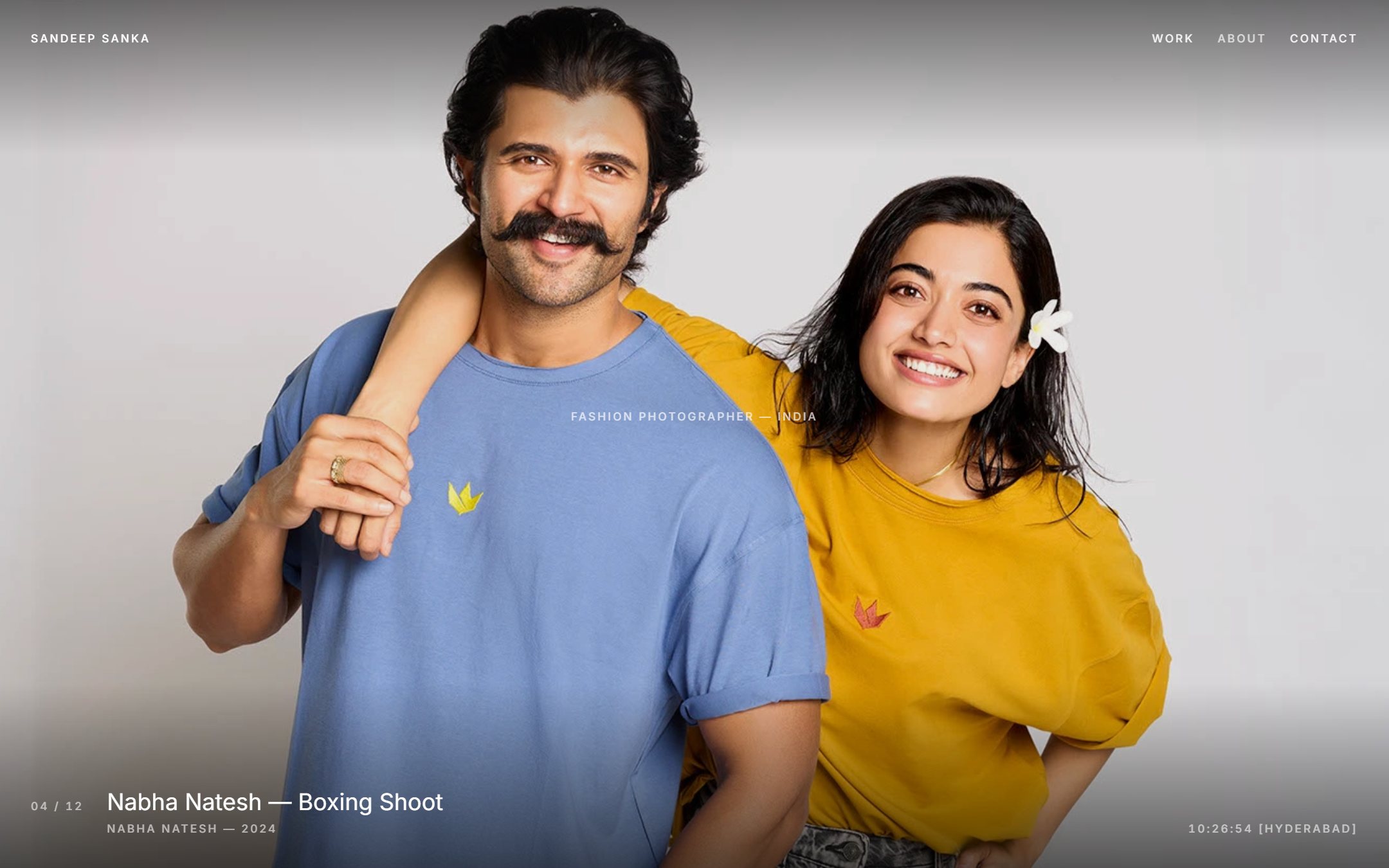
A cinematic, image-first site for an established Hyderabad fashion photographer whose editorial and campaign work includes Allu Arjun, Vijay Deverakonda, Rashmika Mandanna, and houses such as RWDY.
Live at sandeepsanka.com — a full-bleed, motion-paced editorial site built with Next.js, TypeScript and GSAP.
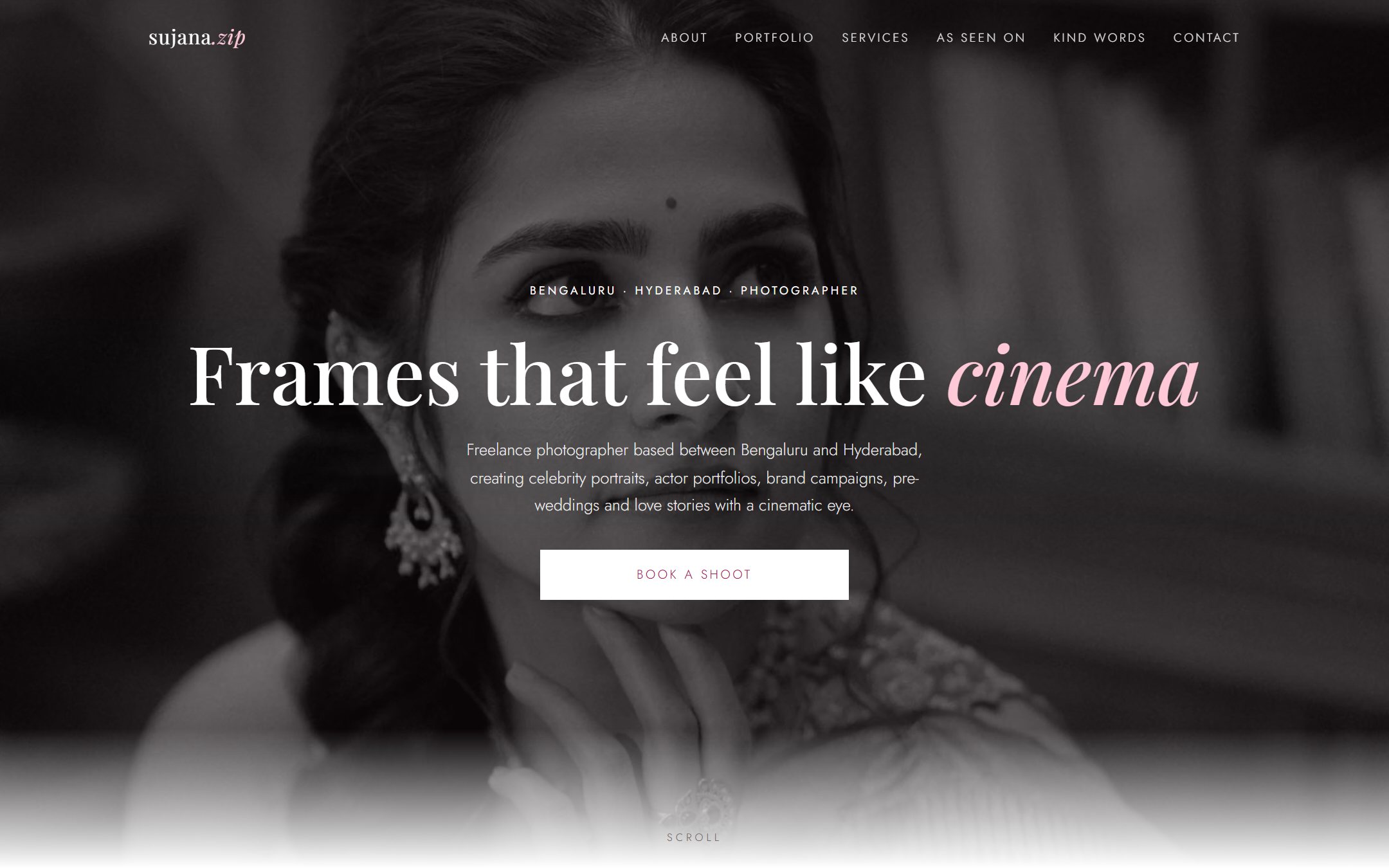
A cinematic, film-still portfolio for a freelance photographer shooting celebrity portraits, actor portfolios, brand campaigns, and pre-weddings between Bengaluru and Hyderabad.
Live at sujana.zip — a monochrome, film-still portfolio built with Next.js and TypeScript.
Portrait, drawn from live data — the loom remembers your movement.
A software engineer specializing in practical AI integration and the systems around it.
My day-to-day work crosses .NET services, EF Core and SQL Server data layers, Angular and TypeScript interfaces, Azure delivery, and LLM-powered product features. I care about grounded outputs, explicit failure modes and what happens after the demo reaches production.
My production experience includes fintech software at Safe Financials and enterprise systems at AmpleLogic. The public projects below show the same approach in the open: working code, tests and documentation.
I also design and build personal sites. The Portfolios collection is that side of the practice: a live photographer’s site and an editorial personal portfolio, composed as custom work rather than a template.
Based
Hyderabad, India
AI
LLM integration · RAG · evaluation · guardrails
Engineering
.NET · C# · Angular · TypeScript · SQL Server
Delivery
Azure · CI/CD · observability · rollback design
Fig. 01 — emblem, drawn to spec
03 / Capabilities
Capabilities
The parts of AI development that turn a promising prototype into software a team can inspect, test and operate.
01
AI Product Engineering →
Choosing where a model belongs, designing structured contracts around it, and building explicit fallbacks instead of treating the provider as magic.
Claude & OpenAI APIs
Structured outputs
Prompt caching
Fallbacks
02
Retrieval & Agents →
Citation-first retrieval, tool boundaries and human approval paths that keep AI systems useful without hiding uncertainty.
RAG
Tool boundaries
Human in the loop
Exploring: MCP · Agent workflows
03
Evaluation & Safety →
Regression gates, evidence checks, privacy boundaries and adversarial cases that measure behavior before an AI change ships.
LLM evaluation
Guardrails
Cost & latency
CI gates
04
Production Systems →
ASP.NET Core services, Angular and TypeScript interfaces, SQL data layers, Azure delivery, telemetry and recovery plans built for the environment that actually runs them.
.NET
Angular
Azure
SQL Server
CI/CD & observability
04 / Contact
Build AI people can trust.
Open to full-time roles and product engineering work — especially teams shipping AI features that have to hold up in production.